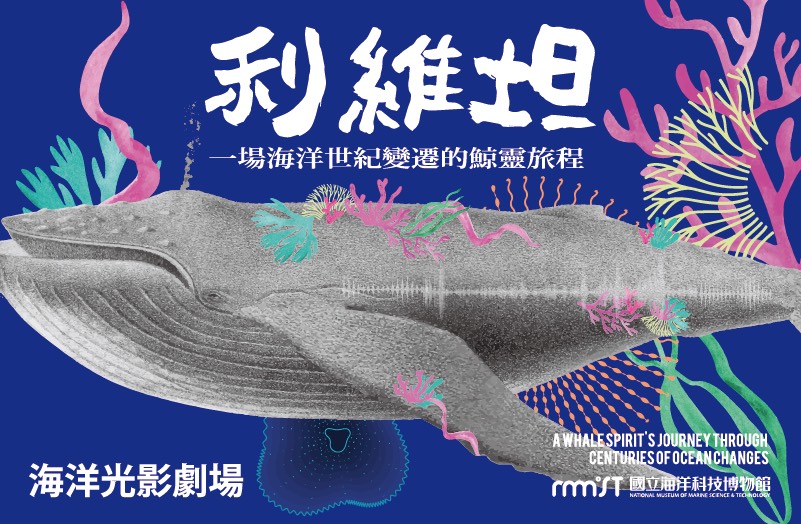
The whale spirit “Leviathan” is an ancient giant being that merges mythological imagery with the form of a humpback whale. Its body is covered in shimmering patterns like spectral lines, carrying luminous coral, relics of ancient civilizations, and ocean memories as it travels across deep time in the ocean, witnessing the abundance, transformation, and disturbance of marine life.
With Leviathan as its central character, this exhibition reinterprets the mythological beast, long associated with primordial power, as a whale spirit that safeguards the ocean. Leviathan is no longer a terrifying sea monster, but a witness and guide of the ocean. Its body, songs, and movements carry traces left by the encounter between the ocean and human civilization.
Rather than addressing environmental issues through direct instruction, the exhibition invites audiences into a fully immersive space. Through surround projection, directional sound, low-frequency vibration, wind, mist, and interactive sensing, visitors experience the ocean's passage from primal abundance to gradual disturbance, and finally toward the hope of restoration. Audiences are not positioned outside the ocean as observers; they are placed within currents, light, and sound, sensing how human activity affects the habitats, perception, and communication of marine life.
Leviathan takes the real-world humpback whale as its visual prototype, drawing on its epic scale and its complex, ever-changing vocal frequencies. The coral, light patterns, and ancient relics on its body are not biological realism, but artistic symbols: coral represents interdependence and symbiosis; spectral lines symbolize communication and perception in the ocean; ancient relics suggest time, memory, and the enduring traces of human activity within the sea.
Narrative Setting
The story begins in a pristine, life-filled primordial ocean one hundred years ago. The enormous whale spirit Leviathan, covered in luminous spectral lines and colorful coral, glides slowly through deep blue waters. Jellyfish, schools of fish, and underwater light unfold with the currents, while song, light, and life echo one another. At this moment, the ocean is not only a magnificent landscape, but also a living system with its own rhythm, order, and modes of communication.
As civilization develops, the seascape begins to change. The distinctive iridescence and metallic sheen of oil pollution emerge, spreading like flowing liquid throughout the surroundings. This seemingly beautiful gloss expands across the imagery and space, encircling the audience and placing them within the transformed state of a disturbed ocean. Instead of directly reproducing a polluted site, the exhibition translates oil pollution into a visual language of shine, layers, and unease, allowing audiences to sense the ocean's gradual imbalance within an atmosphere where beauty and crisis coexist.
Steel shadows from ship hulls then enter the sea, while intense sonar pulses penetrate the space. Leviathan's once-clear and flowing spectral lines of communication are disrupted and broken, and the ocean's original acoustic rhythm is gradually covered by external noise. Through low-frequency vibration, directional sound, and visual signals, the exhibition transforms the pressure faced by marine life under human-made noise into an experience that can be heard, seen, and physically felt.
In the end, the narrative returns to the ocean's resilience and the possibility of action. Through collective interaction, audiences participate in the symbolic act of parting oil pollution, repairing spectral lines, and restoring resonance. As the ocean's light, sound, and life gather once more, Leviathan again releases a deep-sea call. This is not an overly simplified happy ending, but a reminder about choice: the ocean will not automatically return to its former state, yet when humanity is willing to take timely action, protect marine environments, reduce pollution, and lower disturbances, life still has the chance to unfold again.
A Prelude and Afterglow of Color Perception
This exhibition collaborates with gradient artist Hsieh Chen-lin, Damonxart, using light, color, and gradients to open a sensory prelude into the deep-sea story. Before entering the theater, audiences are gradually guided away from the rhythm of everyday life and into a flowing, profound ocean world.
After the story of Whale Spirit Leviathan concludes, the space transitions into three interactive experiences. One section continues Hsieh Chen-lin's color-based creation, offering audiences a healing and quiet moment of pause. The other two sections take marine life, ocean currents, and deep-sea scenes as their themes, allowing visitors to continue sensing the flow and transformation of the ocean world. Together, the three experiences extend the theater's worldview, keeping the space open to exploration, perception, and lingering even after the story has ended.
Key Curatorial Messages
1 | Translating Myth into Ocean Stewardship
Leviathan is transformed from a mythological sea monster into a whale spirit guardian, turning an ancient legend into an emotional entry point for contemporary ocean issues. Through Leviathan's perspective, audiences come to see the ocean not merely as a natural landscape, but as a world with memory, sound, and its own living rhythm.
2 | Transforming Ocean Change into Sensory Narrative
The exhibition translates the impact of human activity on the marine environment through the iridescent metallic sheen of oil pollution, ship shadows, sonar pulses, and low-frequency vibration. Changes that are usually difficult to perceive are brought concretely before the audience through light, sound, and space.
3 | Balancing Sensory Immersion and Ocean Science Communication
The experience uses high-resolution projection, sound design, environmental effects, and interactive sensing to create a theatrical experience with strong dramatic tension. At the same time, the story helps audiences understand how oil pollution and human-made noise interfere with the lives and communication of marine species.
4 | Revealing the Ocean's Resilience
Leviathan's journey from disturbance to renewed song conveys that the ocean has resilience, but recovery takes time and requires active human change. Marine protected areas, pollution reduction, noise reduction, and ocean-friendly choices are all concrete actions that allow marine life to continue.
5 | From Observers to Participants
From entering the theater and experiencing the story to joining the subsequent interactive experiences, audiences move from being viewers to becoming part of the narrative. The exhibition seeks to make ocean conservation more than an abstract slogan, turning it into a responsibility that can be understood and shared through bodily sensation, emotional resonance, and collective interaction.